AI
Agile Robots raises $500 million: physical AI leaves the lab
Munich robotics maker Agile Robots raised $500 million at an $8.5 billion valuation. What physical AI means for German manufacturers and their suppliers.
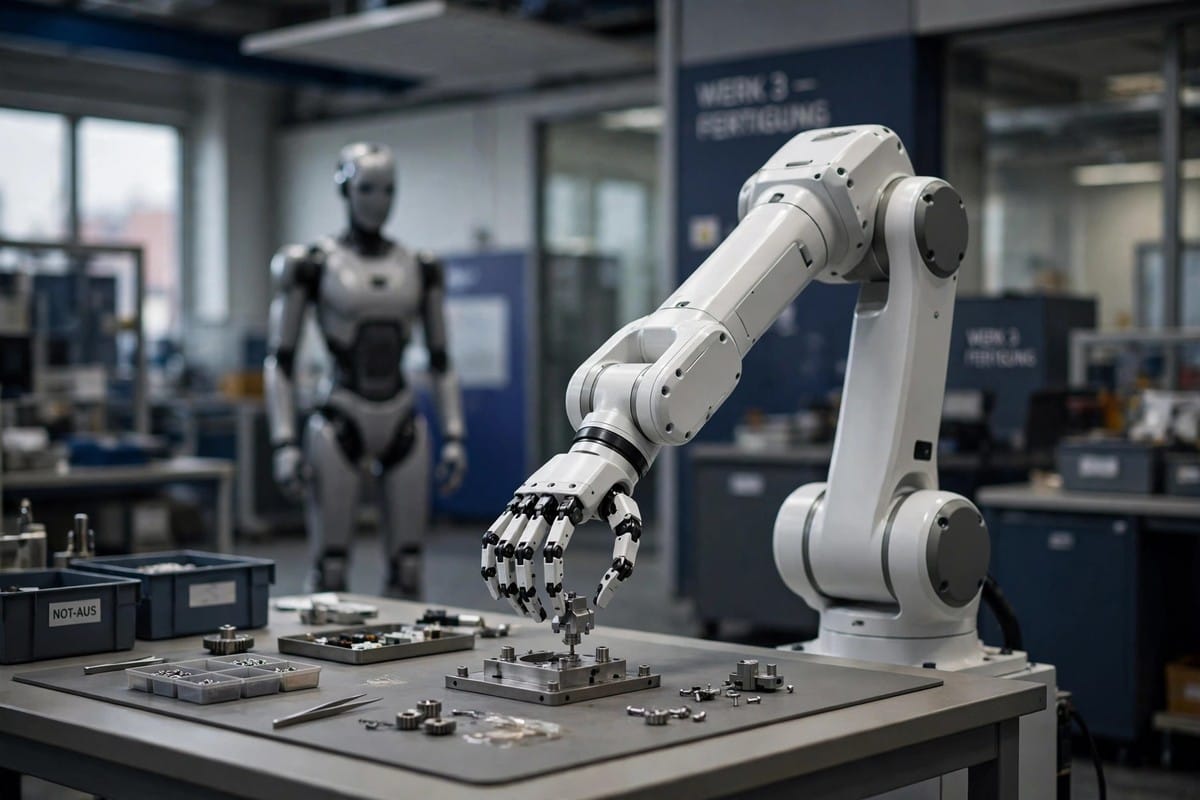
Agile Robots, a robotics company from Munich, raised $500 million on 12 November 2026. SoftBank led the Series F round, with Nvidia, Hitachi and T Capital joining. The round values the company at $8.5 billion and brings total capital raised to about $2 billion.
What the company does
Agile Robots was founded in 2018 as a spin-off from the German Aerospace Center. It builds humanoid and mobile robots, robotic arms and dexterous hands, along with the AI models that control them. Its flagship arm, Diana 7, has torque sensors in all seven axes, so it can feel how much force a task needs. Its humanoid robot, Agile One, was unveiled in November 2025 as an industrial-first platform, built to work alongside people on a production floor. A compact version, Agile One S, is made for research labs and developers, and the Agile One SN comes preconfigured for Nvidia's Isaac GR00T AI models, which act as the robot's brain.
The company says it has deployed around 20,000 industrial robotic solutions for customers in automotive, consumer electronics, logistics and other industries. It employs more than 2,000 research and development specialists and holds over 650 patents. Its subsidiaries include Franka Robotics, Idealworks, BÄR Automation and Krause Automation.
In early 2026, Agile Robots opened a plant in Fürstenfeldbruck, near Munich, that can build up to 10,000 legged and wheeled humanoid robots a year.
What the money is for
The company says the funding will support expansion into the United States, hiring more engineers and faster development of intelligent robotics applications. It also plans to expand production, including in Germany.
Founder and chief executive Dr. Zhaopeng Chen put it this way: 'Physical AI will fundamentally change how the world builds, moves and makes things.' The quote comes from the company's announcement, reported by SiliconANGLE on 12 November 2026.
What physical AI means
Physical AI is AI that moves things in the real world. A chatbot answers a question. A robot with force-sensitive hands picks up a delicate part, feels the resistance and adjusts. That is the step from software to the factory floor.
Three things make this round different from a normal startup raise. First, the customers already exist: 20,000 deployed systems is not a demo. Second, the investors are the supply chain: Nvidia supplies the AI models, Hitachi is an industrial buyer and partner, SoftBank brings capital at scale. Third, the factory already stands: the Fürstenfeldbruck plant opened before the round closed.
What it means for a German manufacturer or supplier
If you supply parts to a factory, your customer is about to change how it builds. A robot that handles delicate assembly changes which parts are ordered, in what tolerance and in what volume. Ask your biggest customers what they are automating next, and when.
If you run a small factory, the relevant question is not whether to buy a humanoid robot. It is which single repetitive task costs you the most hours, and whether a standard robotic arm can take it over. Agile's Diana 7 arm and its competitors sell arms first, and humanoids later.
If you hire in production, the skill mix shifts. The work that grows is setting up, supervising and maintaining robots, not standing beside them. A training plan for two or three people is a realistic first step.
If you are planning that step, our workflow automation and digital systems services help you find the right process first.
What to watch
Competition is strong. In industrial arms, Agile faces Universal Robots, ABB, FANUC and Yaskawa. In humanoids, its rivals include Figure AI, Apptronik and Agility Robotics. A $500 million round buys speed, not a finished market. Watch two numbers: how many robots the Fürstenfeldbruck plant actually ships in 2027, and how many of the 20,000 deployed systems turn into repeat orders.
Takeaway
Physical AI is leaving the lab and entering German factories, with German capital, German production and global investors behind it. For a supplier or a small manufacturer, the useful response is not to buy a robot this week. It is to find the one repetitive task that costs the most hours, talk to the customers who are automating, and train a small team to work with the machines that are coming.
Frequently asked questions
What is physical AI?
AI that moves things in the real world. A robot with force-sensitive hands picks up a delicate part, feels the resistance and adjusts, instead of only answering a question on a screen.
Is Agile Robots only for big factories?
No. Its arms and software are sold to manufacturers of many sizes, and its subsidiaries serve different niches. The humanoid robot is aimed at industrial use first.
When will the robots be widely available?
The Fürstenfeldbruck plant can build up to 10,000 legged and wheeled humanoid robots a year. Watch how many it actually ships in 2027, and how many deployed systems turn into repeat orders.
Working on something like this?
Tell us what you are building. We reply to every enquiry.
Related service: AI Search Visibility (GEO)
Only 19% of Canadian businesses use AI. Free training is coming
The Canadian Chamber of Commerce is launching a two-year AI training program for small businesses, backed by Google.org. What it offers, and what to do before January 2027.
Read article
Gemini 4 Hydrogen: fast AI for the everyday work your business runs on
Google's new Gemini 4 Hydrogen is built for speed: 2.5 times faster than the model it replaces, at $1.50 per million input tokens, and now the default across Google's products.
Read article
Google's Gemini Decisions API: AI that decides in 150 milliseconds
Google's new Decisions API answers up to 1,000 yes or no questions in one request, in about 150 milliseconds. Here is what a small business can do with it.
Read article