AI
A Canadian sign shop built its own AI tools
A Cambridge sign shop built two free AI tools on open-source models. Here is why that worked, and how your business can find its own one-tool idea.
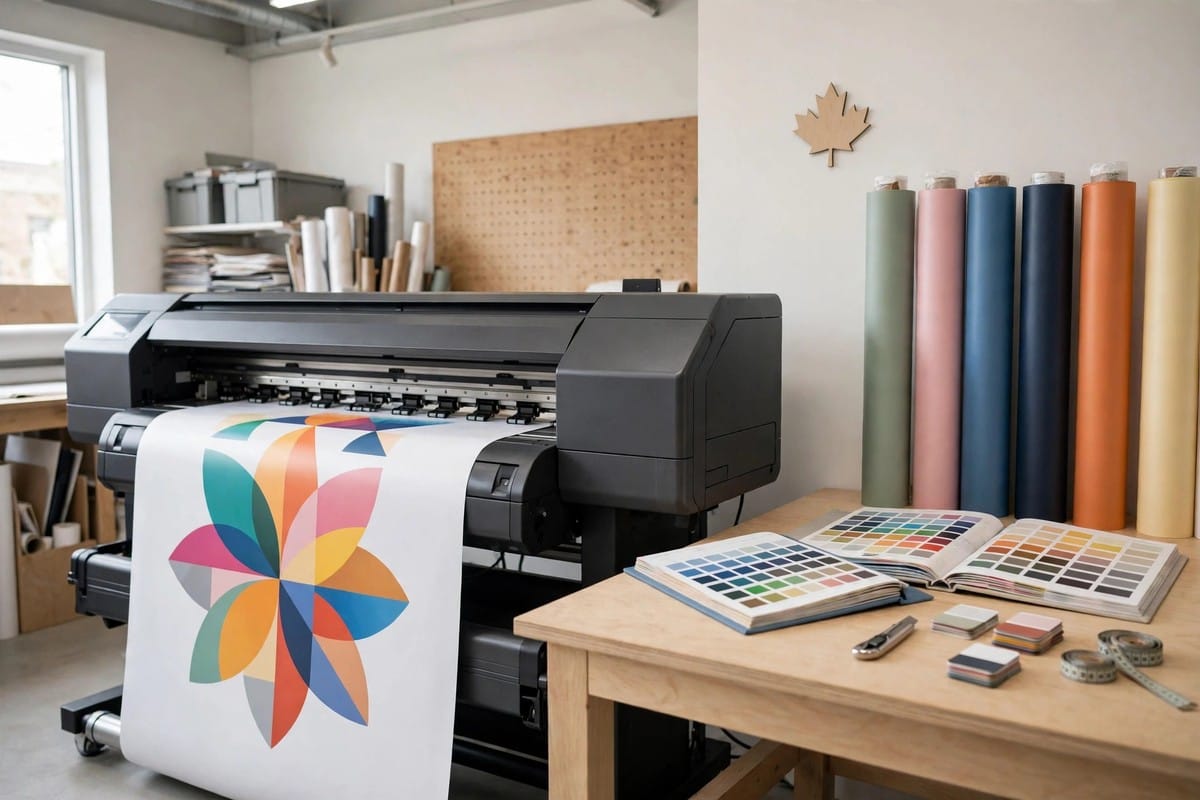
Anyone who has ordered a banner or a vehicle wrap knows the problem: the only copy of the logo is a small image saved from a website, and it needs to be printed metres wide. Galt Signs and Graphics, a sign shop in Cambridge, Ontario, did not buy a software subscription to deal with it. The shop built its own tools and put them online for anyone to use, free.
What the shop built
The shop now runs two web tools. Upscaler.ca uses AI to enlarge small images for print, and Vectorizer.ca turns pixel images into editable vector files for printers, vinyl cutters and lasers. Neither needs an account, and both process images on your own computer rather than uploading them, according to the sites.
Upscaler.ca enlarges logos, artwork and photos up to 16 times, to as much as 30,000 pixels a side. Instead of choosing a pixel size, you enter the print size and DPI you need, and the tool works out the rest and rates how sharp the result will be. It offers different AI models for logos and text, flat clip art and photos, plus a face-restoration option for portraits, and saves PNG, JPG or TIFF files.
Vectorizer.ca traces images into vector paths, keeping every colour or reducing them to as few as two, and lets you click any area to delete or recolour it. It exports to the formats that sign and maker equipment actually uses: layered SVG, CMYK PDF and EPS for print, DXF and HP-GL for vinyl cutters, and G-code for lasers and pen plotters. Small or blurry images are sharpened with AI before tracing, the site says, so the traced shapes come out cleaner.
The shop also publishes a free library of 481 Ontario regulatory road sign drawings with their MTO codes on its resources page.
Why this is suddenly possible
Three things make a project like this realistic for a business that is not in the software industry.
First, the AI models are open. Both tools list their models on the page, and they are open-source projects anyone can use under permissive licences, including Real-ESRGAN (BSD-3-Clause) and GFPGAN (Apache-2.0), plus upscaling models by Philip Hofmann. A small business does not have to train anything. It has to choose, combine and package models that already exist.
Second, your computer does the work. Upscaler.ca runs the AI on the visitor's own graphics card, in the browser, and the models work offline once downloaded. That means no servers to pay for as usage grows, and no customer files to store or protect. It also helps with the barrier businesses cite most: in the same Statistics Canada survey, cybersecurity or privacy concerns (13.4 percent) topped the list of things limiting AI use, ahead of cost (10.6 percent).
Third, the skills are closer to home than they used to be. Galt's owner, Anmar, writes on the company's site that he has had a passion for technology since he was a kid, left the sign industry for a while to study information technology, then worked as a signage broker before opening the shop. Plenty of small businesses have someone like that: an owner or employee with a technical background and a clear view of the problem.
What the shop gets out of it
Every page of both tools says who made it, and each one's FAQ answers the obvious follow-up: can the shop print or install the result for you? The shop also lists both tools on its own resources page.
A free tool is marketing people actually use. For a local business, being the one that solved someone's problem, before they ever asked for a quote, may be worth more than another ad. It can also fix the business's own bottlenecks: artwork that arrives too small or in the wrong format costs print shops time, and a tool that solves it helps the shop and its customers alike.
The limits
Your hardware matters. Because the AI runs locally, results on an older laptop can be slow, and the tool's most detailed photo mode is meant for computers with a graphics card.
AI cannot invent what is not there. Upscaling adds plausible detail, not the original detail. For brand logos, a proper vector file from whoever designed the logo is still the best source, and AI-traced vectors still need a human check before they go to print.
And licences still apply. Open-source models come with terms. Builders need to read them. Galt's tools credit each model and its licence on the page.
How to find your own one-tool idea
The lesson is not that every bakery should write software. It is that the cost of building a small, specific tool has dropped far enough that the question is worth asking. If customers keep hitting the same problem before they can buy from you, and open models or free platforms can solve it, a tool you build can solve it for them and put your name in front of new customers at the same time.
Ask yourself four questions:
- What problem do customers hit again and again before they can buy?
- Can an open model or a free platform solve it?
- Can the tool run on the customer's computer, so you manage no servers and no customer data?
- Does the tool answer the follow-up question of who does the real work, which is you?
The numbers behind this are clear. In the second quarter of 2026, 19.2 percent of Canadian businesses said they had used AI to produce goods or deliver services in the previous 12 months, Statistics Canada reported in June. That is triple the 6.1 percent of two years earlier. The Business Development Bank of Canada found in its 2026 digital transformation study that only 30 percent of small and medium businesses use generative AI, and that those that do are 24 percent more productive. Among the smallest firms, with one to four employees, 19.9 percent used AI, but 41.4 percent said it is not relevant to their business at all.
For that 41 percent, this may be the more useful way to think about it. AI does not have to mean buying another subscription. It can mean solving one small problem your customers already have, and putting your name on the solution. Our AI website service can build such a tool into your website, and our workflow automation service helps organise the process behind it, so the tool saves you work instead of creating more.
Frequently asked questions
Do I need to know how to code to build a tool like this?
No. Galt's owner had a technical background, but no software company. Many small businesses have someone similar. The models are open, and a simple tool can be built with a web developer or an agency.
What does it cost to run a browser-based tool?
Almost nothing for a tool that runs in the visitor's browser: no servers and no stored customer files. The cost is in building and maintaining it, not in running it.
Will AI upscaling replace a proper logo file?
No. Upscaling adds plausible detail, not the original detail. For a brand logo, the real vector file from the designer is still the best source.
Working on something like this?
Tell us what you are building. We reply to every enquiry.
Related service: AI Search Visibility (GEO)
Black Friday AI deals 2026: what is worth it for a small business, and what is not
Black Friday is today, 27 November 2026. This guide lists the verified AI offers for small businesses, with prices and end dates, and one clear rule for what not to buy.
Read article
Berlin takes a 1 euro stake in Cohere. What sovereign AI means for German SMEs
Germany will take a symbolic 1 euro stake in Cohere, with wide governance rights. This article explains sovereign AI in plain terms and what it means for German SMEs.
Read article
Canada will pay up to 80% of your AI compute bill. What small firms can claim before the deadlines
Canada expanded its AI Compute Access Fund to 1 billion dollars. This plain guide explains the 80 percent and 50 percent rates, the project size limits and the two December and January deadlines.
Read article