AI
AI agents that review, fix and approve your code: what Claude Ship means for small teams
Claude Ship puts three AI agents on your pull requests: one reviews, one fixes failing checks, one approves routine changes. It is in beta for Team and Enterprise plans.
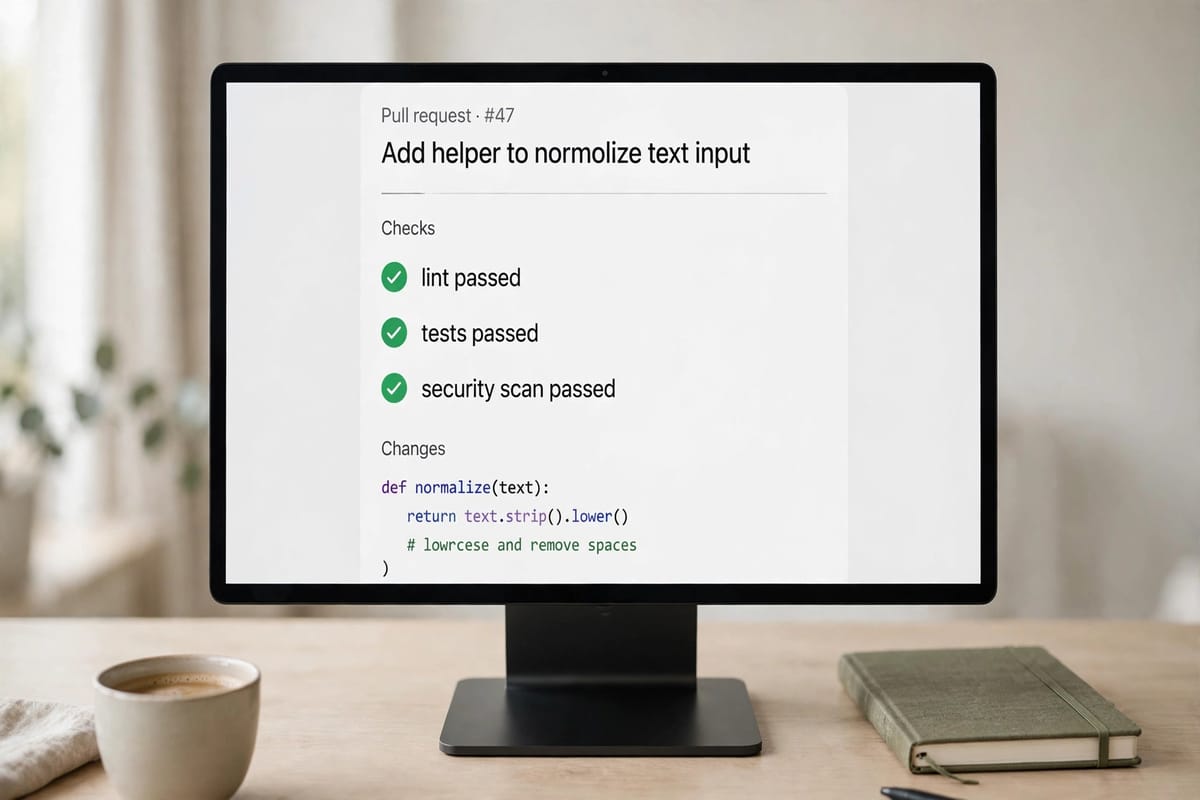
On 23 November 2026, Anthropic launched Claude Ship, in beta for Claude Team and Enterprise plans on GitHub. Three AI agents work on your pull requests: one reviews, one fixes failing checks, and one approves routine changes against a policy file your team writes itself. A new command, /ship, in Claude Code runs the whole flow. For small teams, this is the most practical agent news of the month, because it touches work that happens every week.
What Claude Ship actually does
A pull request is the moment code goes from one person to the team for review. In a small team, that moment is often the bottleneck. Someone waits for a review, the reviewer is in a client meeting, and the change sits. Claude Ship puts three agents on exactly that bottleneck.
The first agent, Code Review, is already generally available. It reads the change and writes a review with concrete notes, like a colleague who opened the file.
The second agent, PR Steward, is in beta. It fixes failing CI checks, resolves merge conflicts, and works through review feedback. That is the work developers like least: waiting for the pipeline to turn green, and fixing conflicts that appeared while they waited.
The third agent, Claude Approvals, is also in beta. It approves routine changes against a policy file the team wrote. The team decides what counts as routine. The agent applies the rules. Nothing outside the rules gets approved.
The three agents, in plain language
Picture a small team building a website for clients. A developer changes the login so customers can reset their password. She opens a pull request.
Code Review reads the change and notes that the error message prints the password into the logs. That is a real note, not generic praise.
PR Steward sees a test failing because a test database was not reset. It fixes the test, reruns the pipeline, and the checks turn green.
Claude Approvals looks at the team's policy file. It says that text changes and small bug fixes under 50 lines may be approved without a human review. The change is bigger, so it goes to a person. The agent knows where its limit is because the team wrote it down.
The point is not that people disappear. The point is that the wait between opening a pull request and getting it approved gets shorter, and the boring repairs are no longer done by the person who wrote the code.
What Anthropic's own numbers show
Anthropic says its own Claude Code team more than doubled merged pull requests from June to September, while reverted pull requests fell by over 40 percent. Those are the vendor's own numbers, from a team building its own tool. Read them as a signal, not a promise. What they show is plausible: when reviews arrive faster and repairs run automatically, teams merge more changes, and when the review is good, fewer changes get reverted.
The number that matters for a small team is a different one: how many hours a week does your team spend waiting for reviews? If the answer is zero, you do not need Claude Ship. If the answer is half a day per person, the bottleneck is real, and it costs money.
How a small team should start
Start with Code Review alone. It is generally available, and it changes nothing about your permissions. Let it run for two weeks on real pull requests and read the notes. If the notes are useful, keep it. If they are noise, switch it off.
Then write the policy file for Claude Approvals before you switch it on. Decide what counts as routine: text changes, small bug fixes, changes to tests. Write down what must never be approved automatically: changes to payments, to authentication, to customer data. A policy file you have not written is not a policy.
Switch on PR Steward only when your pipeline is stable. An agent that fixes failing tests only helps if the tests themselves are trustworthy. If your tests fail randomly, the agent fixes the wrong problem.
And keep approval for anything that touches customers. An agent approval is a process, not trust. A person should still see every change that touches payments, logins, or customer data.
What to watch out for
First, an agent that approves code needs clear rules, and clear rules need a team that agrees. If your team does not agree on what counts as routine, the policy file becomes the next argument.
Second, reviews written by an agent are only as good as the context it has. If your project has no documentation and the rules live only in one person's head, the agent will guess.
Third, the beta runs on GitHub and applies to Team and Enterprise plans. If your team uses a different plan or does not use GitHub, Claude Ship is not available to you yet. Check your plan before you plan around it.
The takeaway
Claude Ship is not a replacement for human review. It is a way to shorten the wait around review. Start with Code Review, write your rules down, and let the agent do the boring repairs. Approval for anything that touches customers and money stays with a person. That is how an agent becomes a colleague you can trust, instead of another shortcut you regret later.
Read more in our guides on custom development and workflow automation, and see how Claude already works in small teams in Claude joins your meetings and builds your spreadsheets.
Frequently asked questions
What is Claude Ship?
Claude Ship is an Anthropic beta, launched 23 November 2026 for Claude Team and Enterprise plans on GitHub. Three agents work on pull requests: Code Review reviews, PR Steward fixes, Claude Approvals approves routine changes.
Which of the three agents are available?
Code Review is generally available. PR Steward and Claude Approvals are in beta. All three work on GitHub, and a new /ship command in Claude Code runs the whole flow.
How does Claude Approvals decide what is routine?
Your team writes a policy file that says what counts as routine and what must never be approved automatically. The agent applies only those rules.
What did Anthropic achieve with Claude Ship?
Anthropic says its own team more than doubled merged pull requests from June to September, while reverted pull requests fell by over 40 percent. Those are the vendor's own numbers.
How should a small team start?
Start with Code Review alone, let it run for two weeks on real pull requests, and write the policy file before switching on Claude Approvals. Keep approval for anything touching payments, logins or customer data.
Working on something like this?
Tell us what you are building. We reply to every enquiry.
Related service: AI Search Visibility (GEO)

Black Friday AI deals 2026: what is worth it for a small business, and what is not
Black Friday is today, 27 November 2026. This guide lists the verified AI offers for small businesses, with prices and end dates, and one clear rule for what not to buy.
Read article
Berlin takes a 1 euro stake in Cohere. What sovereign AI means for German SMEs
Germany will take a symbolic 1 euro stake in Cohere, with wide governance rights. This article explains sovereign AI in plain terms and what it means for German SMEs.
Read article
Canada will pay up to 80% of your AI compute bill. What small firms can claim before the deadlines
Canada expanded its AI Compute Access Fund to 1 billion dollars. This plain guide explains the 80 percent and 50 percent rates, the project size limits and the two December and January deadlines.
Read article