AI
Sovereign AI made in Europe: what Telekom and Mistral mean for German SMEs
Deutsche Telekom is investing 100 million euros in Mistral AI and building an AI factory in Munich. What the European AI stack means for German SMEs.
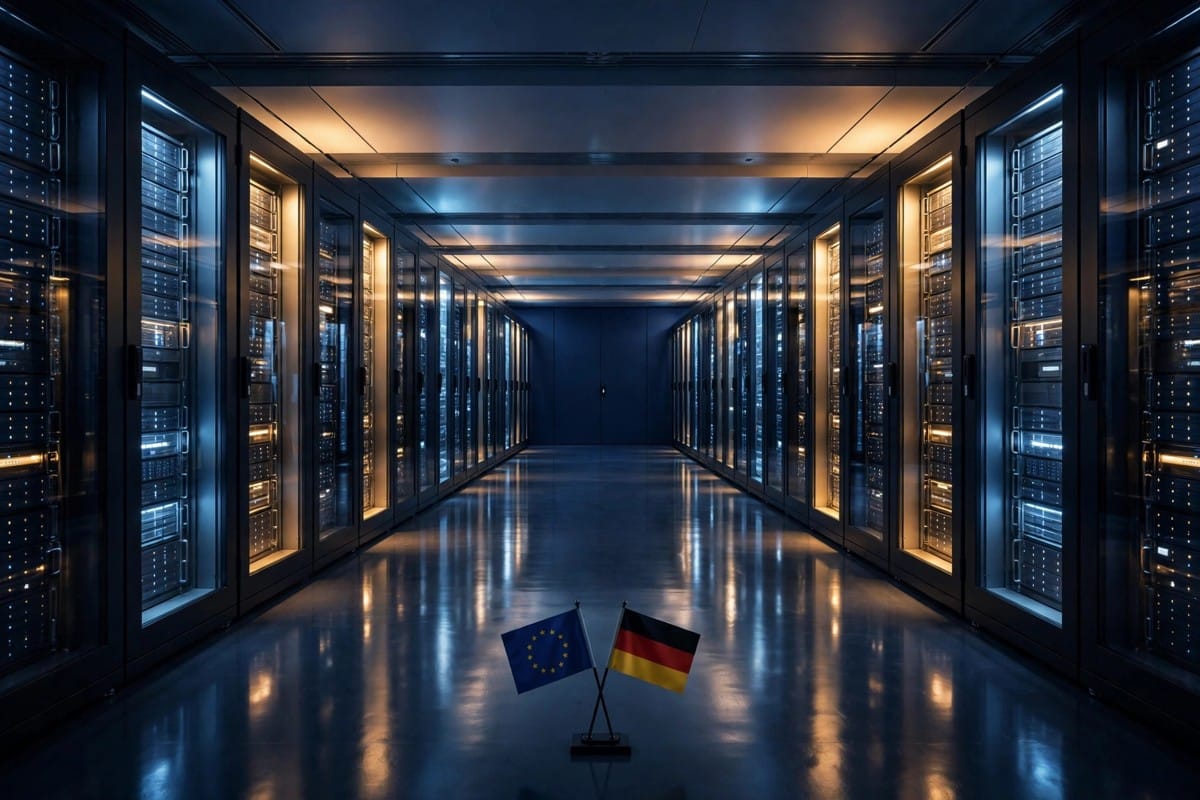
Deutsche Telekom is investing 100 million euros in Mistral AI. The investment, announced on 19 November 2026, comes from Telekom's T.Capital Tech Fund and buys into Mistral's Series D round. It is described as a first step toward a strategic partnership between Germany's largest telecom company and France's leading AI developer.
At the same time, Telekom's AI factory in Munich is moving from announcement to real work. The robotics AI firm microagi has become its first named tenant, training industrial AI models on Telekom's Industrial AI Cloud so that production data stays in Germany. Telekom is spending around 250 million euros to double the Munich site's compute capacity. Users already include Siemens and Daimler Truck.
For German SMEs, this is the moment a European AI alternative stops being a talking point and starts being a product you can buy.
What Telekom and Mistral are building
The partnership has two parts. Mistral builds the models. Its open-weight models can run on infrastructure you control, which is the part that matters most for regulated work. Telekom builds the infrastructure. The Munich AI factory and the Industrial AI Cloud give German companies compute that sits in Germany, under German law, with German support.
The target customers are named clearly: German authorities and industrial firms in regulated sectors. That is the market where data control is not a preference but a requirement.
Why sovereign AI matters to a small business
Sovereign AI sounds like a topic for governments. For a small business, it comes down to three practical questions. Where does my data go? Who can see it? And what happens if the provider changes its terms?
With a US hyperscaler, the honest answer is often that you do not fully know. With a European stack, the data stays in Europe, the contracts fall under European law, and the models can run on infrastructure your provider controls. That does not make it better in every case. It makes it easier to explain to your customers, your auditors and your works council.
German firms already show this preference. Recent surveys report that most German companies prefer AI from German providers. The Telekom and Mistral deal gives that preference a concrete product behind it.
What it does not change
Sovereign AI does not make AI cheaper, and it does not make it better on its own. Mistral's models compete with the big US models on many tasks, but they do not win every benchmark, and the ecosystem of ready-made integrations around them is still smaller. If your team already runs on a US platform and it works well, there is no reason to rip it out this week.
The honest test is simple. List the three AI tools your team uses most. For each one, ask where the data goes and what your customer contracts promise about data handling. If the answers line up, stay where you are. If they do not, a European option is now worth a real trial.
How to try the European stack
Start small. Pick one workflow that touches customer data, for example drafting replies to customer emails or summarising meeting notes. Run it for two weeks on a European model, on infrastructure in Germany, and compare the results with your current tool. Measure three things: quality of the output, time saved, and how easy it is to explain the data flow to a customer who asks.
If the trial works, expand it one workflow at a time. The AI chatbot service and the workflow automation service can help set up a trial on European infrastructure without rebuilding your whole setup.
What to watch next
Watch the partnership itself. A 100 million euro investment is a first step, not a finished product. The interesting news will be the first joint offers: a packaged AI service for German SMEs, with German support and German data hosting, at a published price. Also watch the Munich AI factory. New tenants beyond microagi will show whether the factory becomes a real platform for Mittelstand companies or stays a showcase for large industrial firms.
Takeaway
Telekom's 100 million euro bet on Mistral is the clearest sign yet that Europe wants its own AI stack, and that German business is the customer it is built for. You do not need to switch today. You do need to know the option exists, what it costs, and where your data goes now. Run one small trial on a European model, compare it honestly with what you use today, and let the results decide. That is how a small business buys sovereignty: one workflow at a time.
Frequently asked questions
What is sovereign AI?
Sovereign AI means AI models and infrastructure run under the laws and control of your own country or region, so your data stays in Europe and under European contracts.
What did Telekom announce about Mistral?
Telekom's T.Capital Tech Fund is investing 100 million euros in Mistral AI's Series D round, announced on 19 November 2026, as a first step toward a strategic partnership.
Is Mistral AI good enough for a small business?
Mistral's models compete with leading US models on many everyday business tasks, though the ecosystem of integrations is still smaller. A two-week trial on one workflow is the honest way to find out.
Where does the Munich AI factory fit in?
It provides compute in Germany through Telekom's Industrial AI Cloud. Its first named tenant is microagi, a robotics AI firm, and users already include Siemens and Daimler Truck.
Working on something like this?
Tell us what you are building. We reply to every enquiry.
Related service: AI Search Visibility (GEO)
Black Friday AI deals 2026: what is worth it for a small business, and what is not
Black Friday is today, 27 November 2026. This guide lists the verified AI offers for small businesses, with prices and end dates, and one clear rule for what not to buy.
Read article
Berlin takes a 1 euro stake in Cohere. What sovereign AI means for German SMEs
Germany will take a symbolic 1 euro stake in Cohere, with wide governance rights. This article explains sovereign AI in plain terms and what it means for German SMEs.
Read article
Canada will pay up to 80% of your AI compute bill. What small firms can claim before the deadlines
Canada expanded its AI Compute Access Fund to 1 billion dollars. This plain guide explains the 80 percent and 50 percent rates, the project size limits and the two December and January deadlines.
Read article