AI
Physical AI is reaching German factories: what it means for your business
AI is leaving the screen and entering the factory floor. Here is what the Germany and NVIDIA deal, and the new robot training centre near Munich, mean for your business.
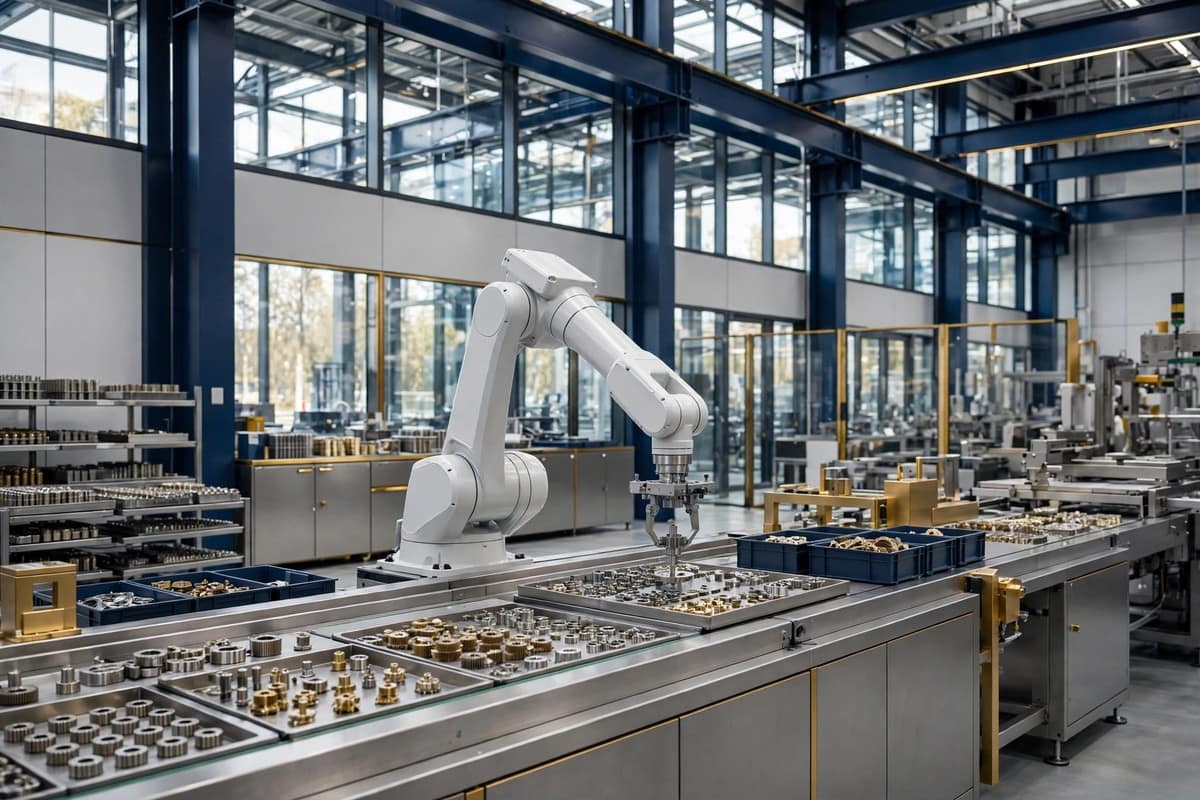
AI is leaving the screen and entering the factory floor. In the last few weeks Germany has signed a deal with NVIDIA to build industrial AI, and a new training centre near Munich is teaching up to 100 robots around the clock. This is no longer a research story. It is a practical question for every supplier, workshop and Mittelstand company: what changes for you, and what should you do first.
What happened this week
At the Invest in Germany Summit, the German government and NVIDIA signed a joint declaration of intent to develop industrial AI and models for physical AI. Chancellor Friedrich Merz, the Federal Ministry for Economic Affairs and Energy, the Ministry of Research, Technology and Space and NVIDIA agreed to build a joint initiative, working with the German Industry 4.0 platform. NVIDIA chief executive Jensen Huang said AI will not replace German engineers but will amplify their skills, according to reports of the summit. NVIDIA also announced planned investments in four German startups: Agile Robots in Munich, Avelios Medical, Mirelo and Reflex Aerospace.
At the same time, Neura Robotics opened a training centre near Munich Airport that the company calls the RoboGym. As many as 100 humanoid and other robots work there around the clock, learning tasks by copying human trainers. The centre was developed with the Technical University of Munich. Neura aims to have five such gyms running worldwide by the end of the year, including one already opened in Hangzhou, China. The company raised as much as 1.4 billion US dollars in June, with the investment led by Tether, and counts NVIDIA and Amazon among its backers. Agile Robots in Munich is working with partners including Google DeepMind, and another company, Humanoid, aims to integrate robots into the operations of car supplier Schaeffler by the end of the year.
Why Germany is the test case
Germany is the natural place for physical AI because the country already leads in the things robots need: mechanical engineering, automotive supply chains, precision manufacturing and industrial automation. The government plan for a KI-Nation by 2030 sets a target of at least 80 percent of large companies and 55 percent of small and medium sized enterprises using AI. Yet a Bundesbank survey reported in early November found only 7 percent of German companies use generative AI on a large scale, even though 68 percent already use it or plan to by year end. The gap between trying AI and using it at scale is exactly where physical AI will be decided.
What it means for suppliers and SMEs
Your customers will start asking different questions. A carmaker or machine builder that trains robots will want suppliers whose processes, data and quality checks fit into an automated line. That does not mean you need a robot tomorrow. It means the boring groundwork matters: clear process documents, clean production data, and quality checks a machine can read. A supplier that can show a stable, documented process will be easier to plug into an automated supply chain than one that runs on habit and memory.
There is also a cost question. Robots trained in a gym still need a real task, a real floor and someone who owns the result. The companies that gain first will be the ones that pick one repetitive, well defined task and automate that, instead of buying technology and searching for a use.
Three practical steps to take now
- Pick one physical task that repeats every day and costs time or causes errors, for example sorting, packing, inspection or moving parts between stations. Write down each step exactly as it happens today.
- Ask your biggest customer what their AI and automation plans are for the next two years. You need to know whether they will expect machine readable quality data, faster turnaround or new documentation.
- Give one person in your team ownership of the topic. Their job is to follow the German physical AI news, talk to one automation vendor, and report back with one concrete proposal, not a stack of brochures.
What not to do
Do not buy a robot before the process is clear. Do not let a vendor define your problem. And do not wait for a perfect national plan: the KI-Nation targets describe where Germany wants to be in 2030, but your customers are making buying decisions now.
Physical AI will reach German factories in steps, not in one leap. The businesses that prepare one process, one data set and one trained person will be ready when their customer calls. Start with the process you already understand best.
See our workflow automation service and our digital systems service. For the national context, read our KI-Nation 2030 guide.
Frequently asked questions
Is physical AI only for large factories?
No. Large factories move first, but suppliers feel the change sooner, because big customers start asking for machine readable processes and quality data. A small firm that documents one process well is in a strong position.
When will robots work in small German firms?
Nobody can promise a date. Robot training centres, new investment and government backing all point the same way: pilot projects in 2026 and 2027, wider use in real production lines after that. The preparation, clear processes and clean data, pays off either way.
Do I need NVIDIA hardware to use physical AI?
No. The point of the Germany and NVIDIA initiative is to build models for German industry, and many tools run on standard hardware or in the cloud. Start with the task, then ask what hardware it really needs.
Will robots replace skilled workers?
The statements from NVIDIA and the German government say the opposite: AI should amplify the skills of engineers and skilled workers. The jobs that change are the repetitive ones. Skilled work, setup, quality control and problem solving, becomes more valuable.
Working on something like this?
Tell us what you are building. We reply to every enquiry.
Related service: AI Search Visibility (GEO)
Your AI tools can now touch your bank account. A small business security checklist
AI assistants now connect to bank accounts and act on your behalf. That is useful and risky. Work through this checklist before you connect anything.
Read article
Canadians are turning against AI. How your business can still earn trust
Ottawa is spending billions on AI while public trust falls. For a Canadian business, trust is now the product. Here is how to earn it.
Read article
Canadian banks block third-party AI agents: what it means for you
RBC, TD, CIBC and BMO are blocking third-party AI agents from their online platforms. What that means for your automation.
Read article